Tools by STON.fi
Made for your own research.
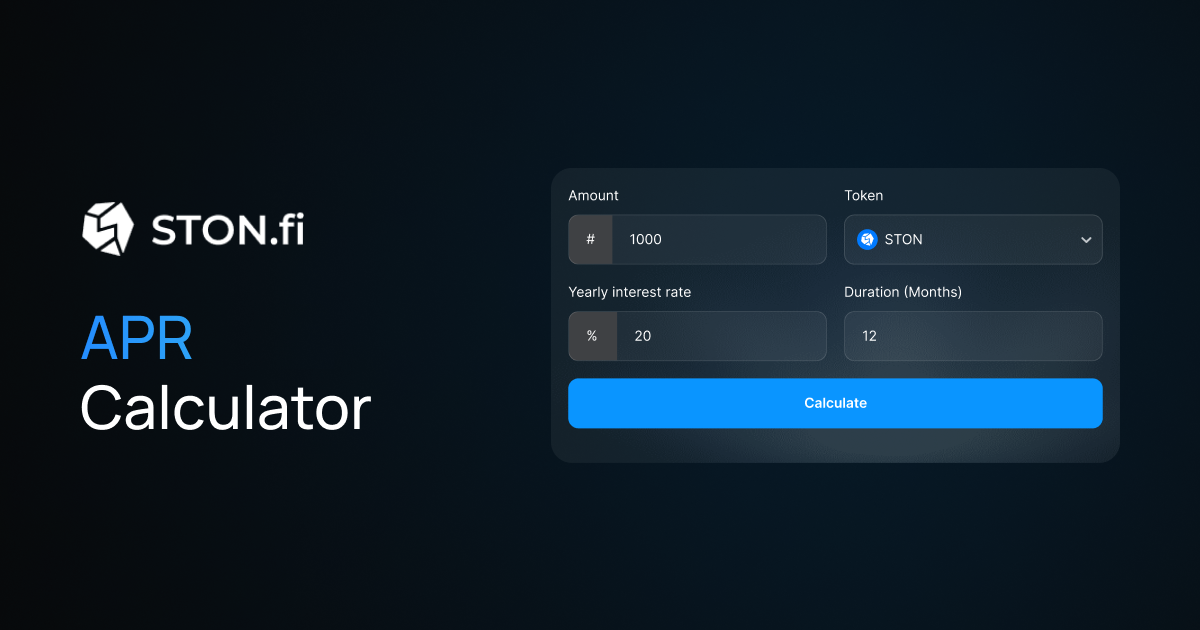
What's the difference between APY and APR?
APR (Annual Percentage Rate) shows your yearly interest without compounding.
APY (Annual Percentage Yield) includes compound interest, meaning you earn interest on your interest.
Example:
If a pool offers 10% APR and compounds monthly, your APY ≈ 10.47%.
How can I estimate my final token amount?
Enter your initial deposit, APR/APY, and time period.
Example:
You stake 1,000 USDC at 12% APY for 1 year → You'll end up with 1,120 USDC (approx).
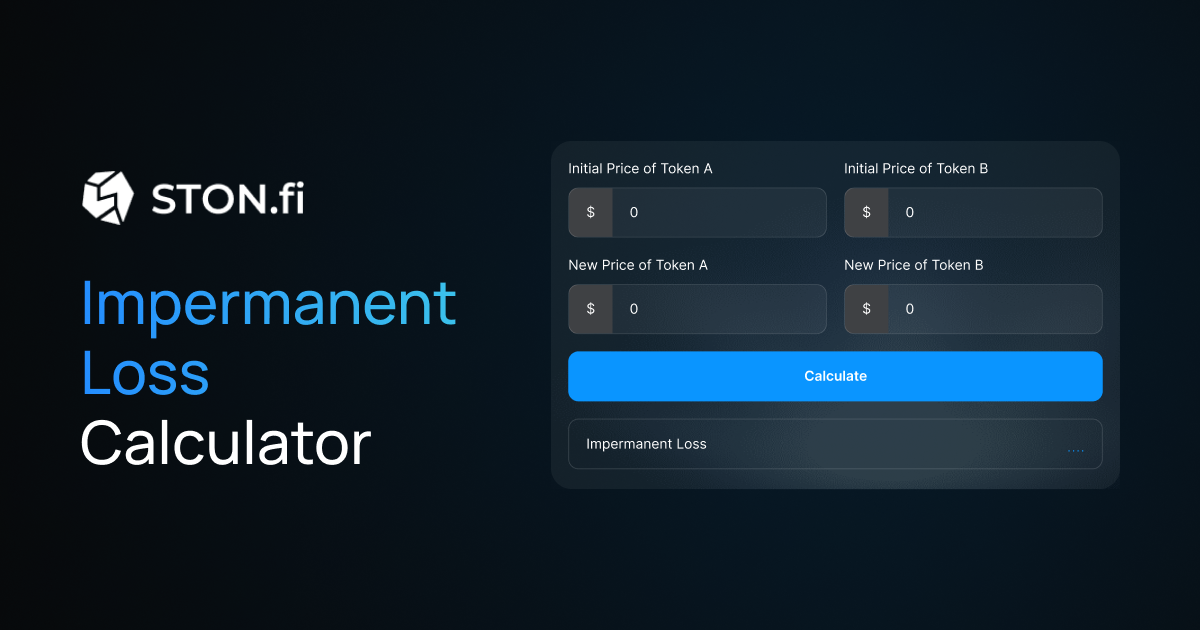
What is impermanent loss (IL)?
Impermanent loss happens when you provide liquidity to a pool (e.g., ETH-USDC) and the price ratio between tokens changes.
When you withdraw, the total value might be lower than if you had just held both tokens separately.
How do I calculate impermanent loss?
Use the calculator by entering the initial and final prices of both tokens.
Example:
You deposited $1,000 in ETH and $1,000 in USDC (total $2,000).
ETH price doubles while USDC stays stable.
The pool rebalances your share to ~0.707 ETH and 1,414 USDC, worth about $2,828.
If you had just held, you'd have $3,000, so your impermanent loss is roughly 5.7%.
Is impermanent loss always bad?
Not necessarily. You might still profit if trading fees and rewards outweigh the IL. Always compare total rewards before deciding.
Are these tools free to use?
Yes! All our DeFi tools are completely free and accessible to anyone interested in DeFi yield estimation and risk assessment.